It comes down to whether they figured out the unwritten rules before sitting down. Magic: The Gathering etiquette isn't a secret code. It's a short list of habits the community has agreed on without ever writing them down. Skip them, and the room feels it — even if nobody says it to your face. Show up knowing the basics, and you've already done more prep than half the people in line.
I've been to a lot of these events. Here's what to actually do, what to skip, and how to follow positive magic the gathering mtg events etiquette so you can enjoy round one, meet great people, and have a fun experience at the table.
TL;DR Quick Answers
Magic: The Gathering MTG Events Etiquette
Magic: The Gathering events etiquette is the unwritten social code that decides whether the people at your local game store are glad you showed up. It comes down to respect, hygiene, and tempo, in that order.
The core habits every player should know before walking into an event:
Shower and brush your teeth before you go. Tables sit close together for hours.
Bring your own dice, sleeves, life pad, and tokens. Borrowing once is fine. Every round is not.
Never touch your opponent's cards without asking. Ask first, every time.
Play at a steady pace. Don't tank for five minutes every turn.
Call a judge for rules disputes. It's the polite move, not a rude one.
Say "good game" after every match. Win or lose.
Match the pod's tone in Commander. Don't pub-stomp a casual table with a high-power deck.
Behavior at the table outlives win rates. The community remembers who behaved well long after they forget how anyone played.
Top Takeaways
MTG etiquette is mostly about respect, hygiene, and tempo, roughly in that order.
Most first-event mistakes are social, not strategic.
Calling a judge isn't rude. It's the right move.
Your local store remembers how you behaved long after they forget how you played.
The Most Common Etiquette Mistakes at a First MTG Event
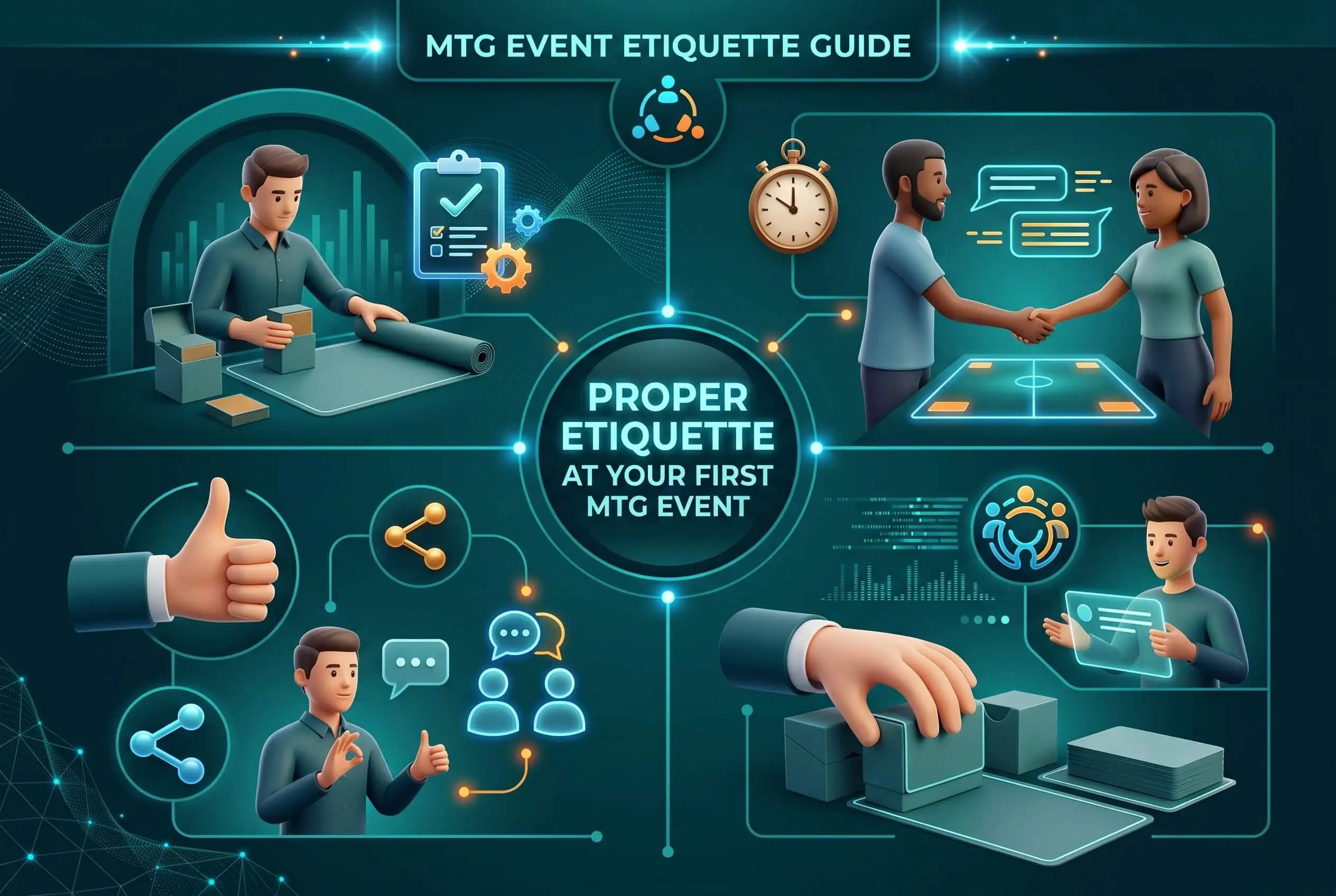
Almost every slip-up at a first event is social, not strategic, even when using a magic the gathering life counter at the table. Nobody at the table expects you to play perfectly. They do expect you to show up clean, respectful, and ready to keep the game moving. The ten habits below trip up new players the most. Knowing them in advance puts you ahead of where I was at my first prerelease.
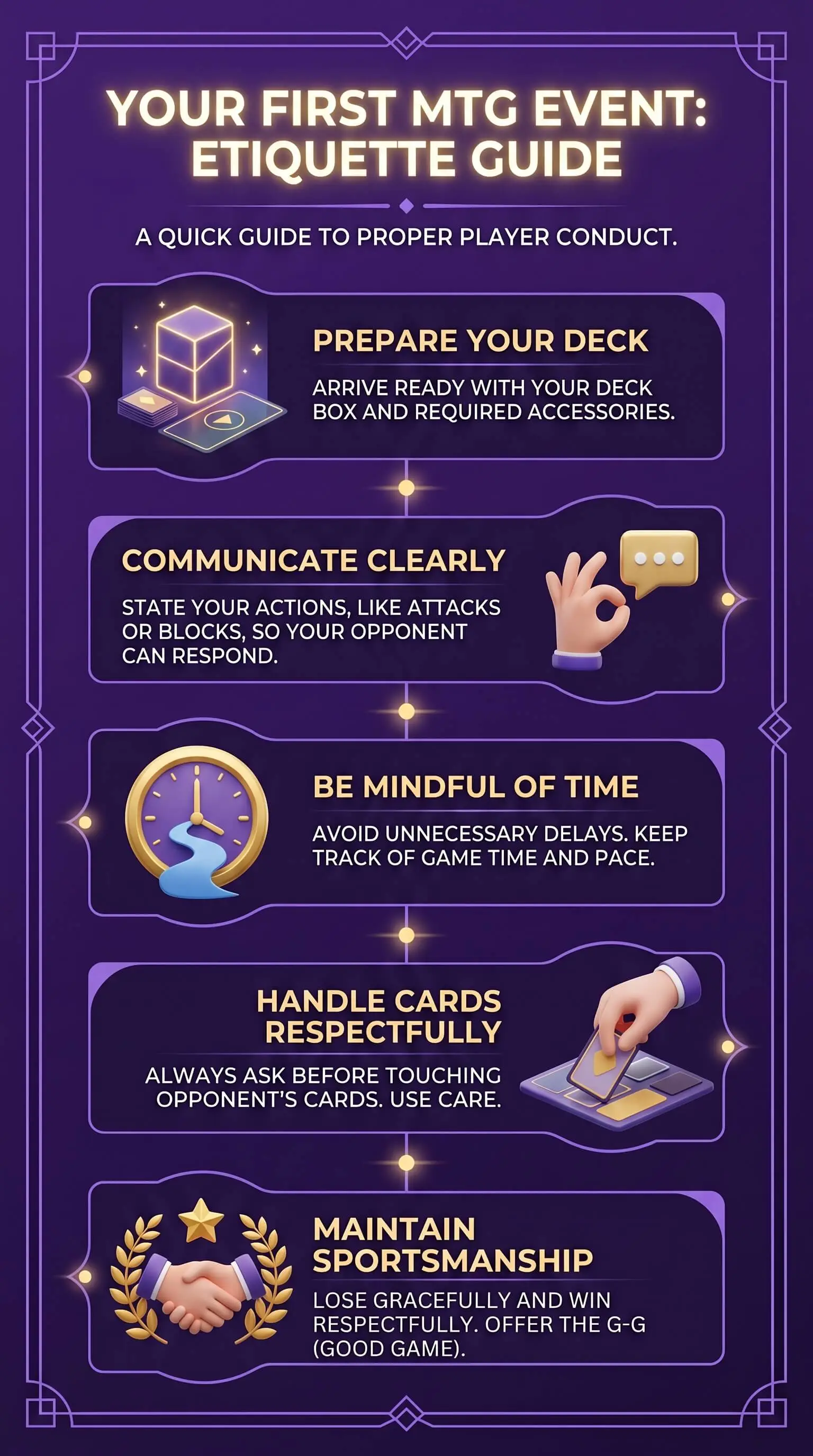
Shower before you show up: There's a reason the community has a name for "con funk." Tables run close together. Rounds last fifty minutes. Your opponent will sit three feet from you for hours. Soap, deodorant, clean clothes, and a quick brush of the teeth put you ahead of the average attendee before you've drawn a card.
Bring your own gear: Sleeves, dice, a life pad or tracker app, and tokens for anything in your deck that makes them. Borrowing once is fine. Borrowing every round gets old fast. If it's a constructed event, have your decklist printed before you walk in. Most stores will print one for you if you ask early.
Don't touch your opponent's cards: Even if a card is face up on their side of the table, you don't reach for it. You ask. "Can I see that?" works every time. Same goes for picking up their dice, peeking at their sideboard, or rearranging anything on their half. Respect the invisible line down the middle of the playmat.
Don't tank forever: Thinking is fine. Tanking is not. If you stare at the same board state for five minutes every turn, you'll annoy your opponent and risk a slow-play warning from a judge. When you genuinely need extra time, say so out loud. "Give me a second to think about this one" buys you patience instead of frustration.
Call a judge, don't argue: Judges exist to answer rules questions, settle disputes, and keep the game moving. If you and your opponent disagree on how a card works, raise your hand and say "judge." This isn't rude. It's the move every experienced player makes. Arguing across the table makes both of you tense. Calling a judge brings the temperature right back down.
Watch the trash talk: Some tables run hot with banter. Most don't. Until you know the room, keep it friendly and brief. "Nice play," "good game," and a fist bump cover almost every situation. Save the chest-thumping for your group chat.
Don't be the railbird who ruins the match: Watching other people's matches is part of the fun. Standing too close, leaning in, or gasping at plays is not. Don't react to information one player can see and the other can't. If you can't watch silently, give the match space and find another to follow.
Say what you're doing: Announce your actions out loud as you take them. "Attacking with both creatures." "Tapping three for this spell." "Trigger on my upkeep." Clear announcements prevent misplays, prevent disputes, and signal that you respect your opponent's right to respond. Mumbling under your breath while moving cards around does the opposite.
Don't kingmake in Commander: Commander pods reward smart politics and punish spite plays. If you get eliminated, don't throw the game to a random opponent because someone else hurt your feelings three turns ago. Play to win while you're alive. When you're out, watch graciously.
Win gracefully, lose gracefully: If you've got lethal, take the win. Don't drag the final turn out to milk the moment. After a win, a simple "good game" and a handshake or fist bump is plenty. After a loss, same thing. The community remembers who behaved well. It also remembers the other kind.
"At my first prerelease I was so nervous I forgot to shuffle the first round. I argued with my opponent over a card interaction instead of calling a judge, and I still cringe thinking about it. None of that mattered the next week. What mattered was that I came back. Behavior at the table outlives win rates, much like professionalism and respect do for a healthcare professional. I've watched players with average decks build real friendships at their local store inside a few months, purely because they were a pleasure to sit across from."
7 Essential Resources
Bookmark these before your first event. Each one solves a specific problem new players run into.
1. Magic: The Gathering Tournament Rules (Wizards of the Coast). The official rulebook for sanctioned events. Skim the sections on player communication and tournament shortcuts before your first FNM. Read it here.
2. Magic Companion App. The official mobile app for check-in, pairings, round notifications, and a built-in life counter. Download it before you walk in. Get it here.
3. Scryfall. The fastest card-search tool the community has. Use it to look up oracle text, rulings, and prices while you're deckbuilding. Try it here.
4. Moxfield. A clean, free deckbuilder for organizing your list and printing a decklist sheet. Most stores accept a Moxfield printout. Build a deck here.
5. Wizards Store and Event Locator. The official directory for finding nearby game stores, their event calendars, and their house rules. Search here.
6. Magic Judges Rules Resource. The annotated tournament rules, maintained by certified judges, with plain-language breakdowns of the trickier sections. Read the annotations here.
7. MatchPunk's full guide to MTG event etiquette. A deeper breakdown of player behavior at the table, with concrete examples of how to avoid being the player nobody wants to face in round one. Read it here.
3 Statistics
The community is bigger and growing faster than most new players realize. A few numbers worth knowing before you show up:
Magic: The Gathering has been played by more than 50 million people worldwide and is published in over 150 countries (Hasbro Investor Relations).
The Wizards Play Network now spans nearly 9,000 retail locations globally, and MagicCon: Las Vegas sold more than 19,000 badges in mid-2025 alone (Star City Games, citing Hasbro Q2 2025 earnings call).
Over 1 million unique players took part in MTG organized play during 2025, representing more than 20% year-over-year growth (Hasbro Q4 2025 financial slides via Investing.com).
Translation: the player sitting across from you at your first event is one of a few million new people the community welcomes every year. You're not the odd one out. You're part of a wave.
Final Thoughts and Opinion
Here's what surprised me when I first started attending events. The strategic side of Magic is the smaller half of the experience. The bigger half is social. The players who get invited back, who get help with deckbuilding, who get tipped off about good deals on singles, are almost never the ones with the strongest decks. They're the ones who showed up prepared, played at a steady pace, called judges politely, and shook hands afterward.
If you're nervous about your first event, that nervousness is actually working in your favor. It means you care about doing this right. Most of the mistakes in this post come from players who didn't think about etiquette at all, not from players who thought about it too much. Show up. Be kind. Ask questions. The rest sorts itself out, just like learning the different categories of MTG life counters over time.
Frequently Asked Questions
"What should I bring to my first MTG event?"
Your deck (sleeved), a printed decklist if it's a constructed format, dice, a life pad or tracker app, tokens for any token-producing cards in your deck, and a positive attitude. The Magic Companion app on your phone handles pairings and round timers. A small playmat is a nice extra but isn't required.
"Is Friday Night Magic beginner friendly?"
Yes. FNM is the most beginner-friendly sanctioned event in the community. It runs at Regular Rules Enforcement Level, which prioritizes fun and social play over strict enforcement. Stores actively welcome new players, and most will pair you against similarly experienced opponents in the early rounds.
"Do I need to sleeve my cards at MTG events?"
Sleeving isn't strictly required at every Regular REL event, but it's strongly recommended. Sleeves protect your cards from spills and wear, and they keep your cards from becoming "marked," which can lead to penalties. Match all sleeves in your deck, and use plain backs.
"How long does a typical MTG event last?"
A standard FNM runs three to four Swiss rounds at fifty minutes each, plus deck registration and short breaks. Plan for three to four hours total. Prereleases and larger events can run six to eight hours. Eat before you go, and bring water.
"Can I drop out of a tournament if I'm losing?"
Yes. Dropping is a normal part of organized play. Tell the scorekeeper or open the Companion app and drop yourself before the next round's pairings post. There's no penalty for dropping, and nobody will judge you for it. Stay if you're having fun, leave if you're not.
"What happens if I make a rules mistake during a match?"
At Regular REL events, most mistakes get corrected on the spot with no penalty. If you realize you made a mistake mid-game, raise your hand and call a judge. Honest errors get fixed. Hiding mistakes is what causes real problems.
Ready to Walk Into Your First Event Without the Cringe?
Most of what we just covered isn't really about Magic at all. It's the same self-awareness that keeps you from sabotaging other parts of your life, including relationships, communication, and even marketing: prep before you show up, respect the people across from you, ask for help when you need it, walk away graciously when it's over. If that resonated, subscribe for more on building real-world confidence in low-stakes social environments. Drop a comment with the strangest etiquette moment you've watched at your local store. We read every one.