
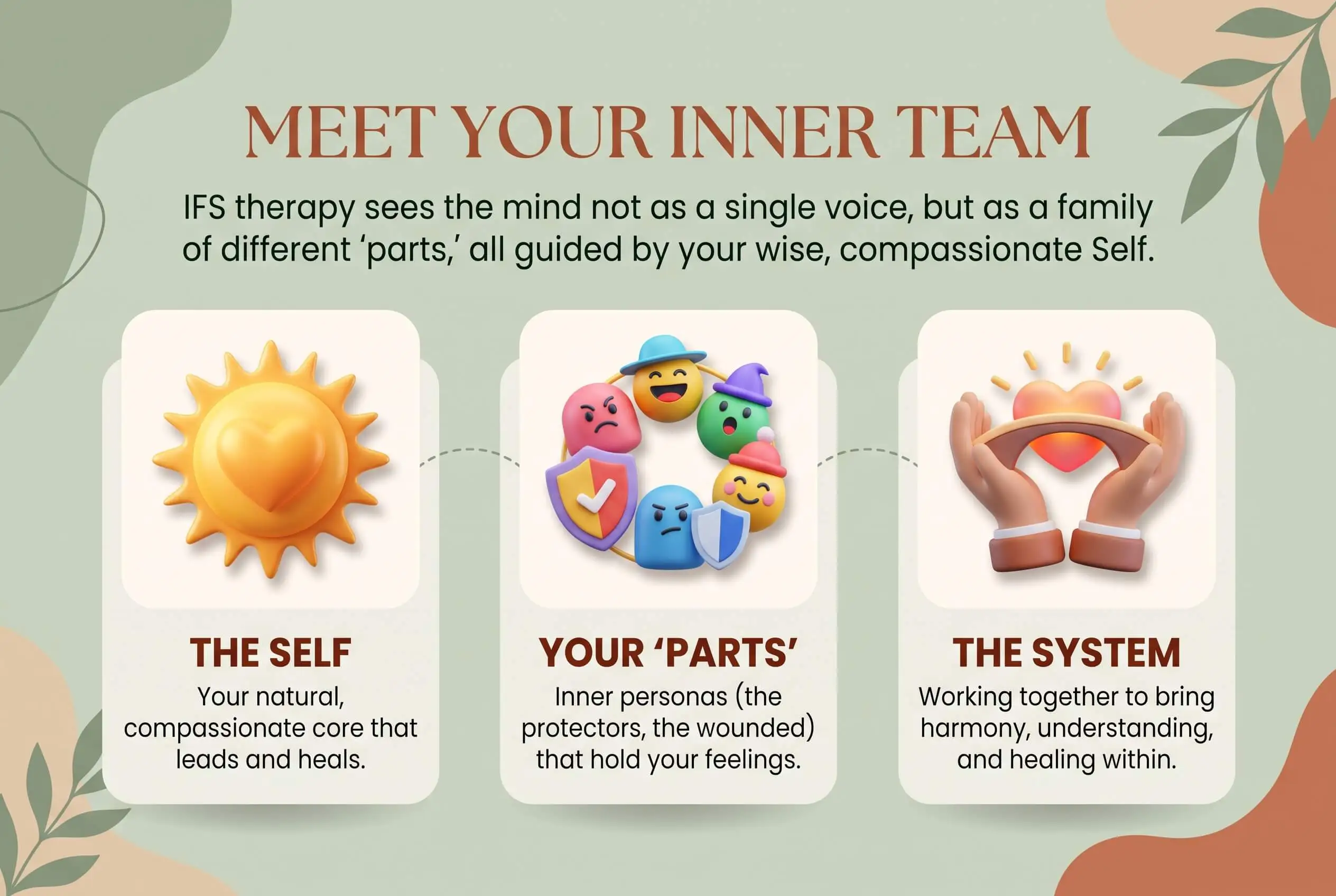
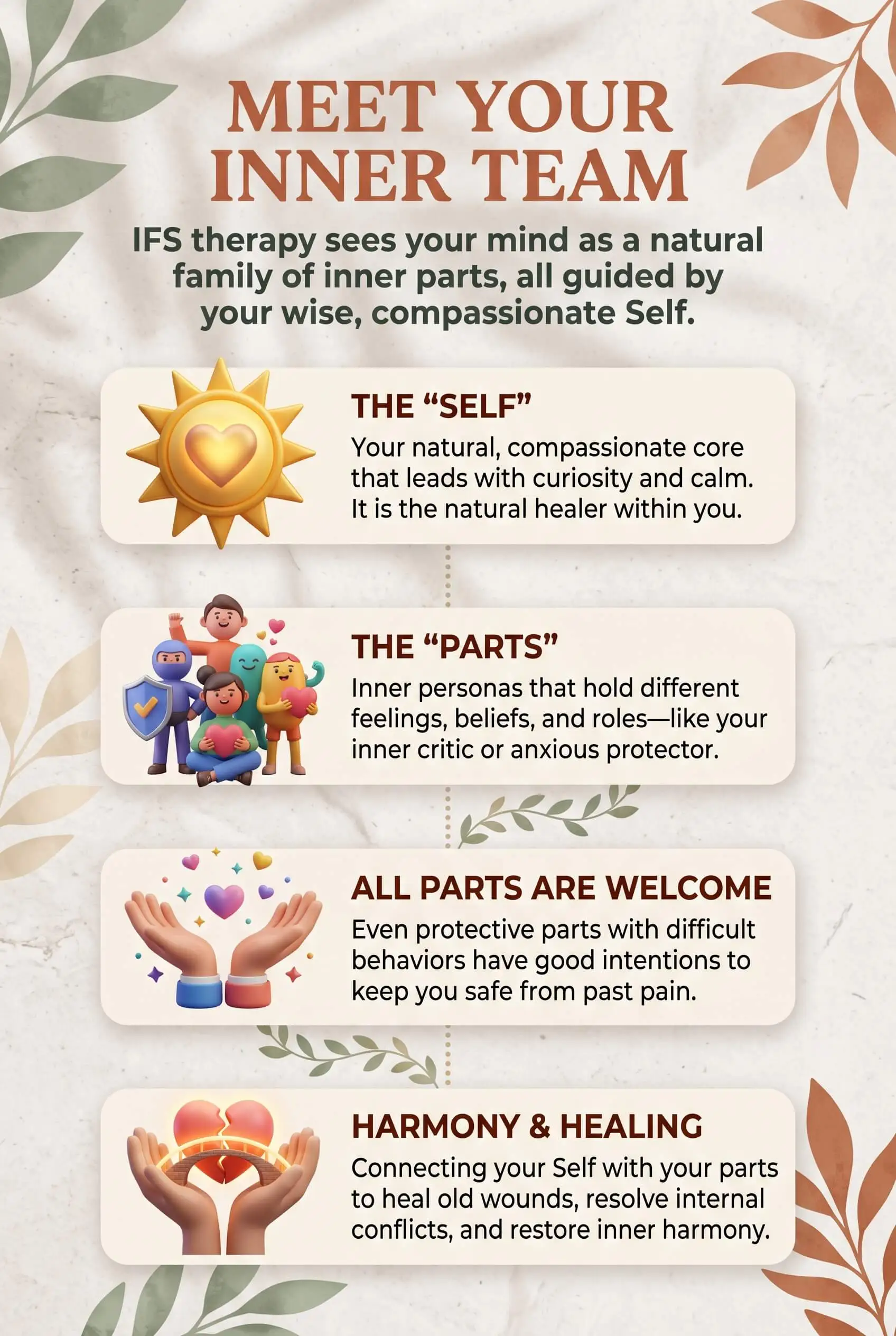
Here's IFS therapy explained in plain words. Your mind holds a lot of parts, each one trying to help in its own way, and underneath them sits a steady, curious center called Self. Internal Family Systems, or IFS, is talk therapy that gets to know those parts rather than trying to get rid of them.
That's the core of it. The harder part is saying it so it lands with someone who's never heard the term.
From the outside, IFS can sound odd. "Parts" can sound like a diagnosis, and "Self" with a capital S can sound like something printed on a poster. It means neither.
It also changes how self-sabotage looks, which matters on a site built around that word.
TL;DR Quick Answers
IFS Therapy Explained
IFS (Internal Family Systems) therapy is talk therapy that treats your mind as a group of parts, each doing a job it took on to protect you, with a calm, curious Self underneath. Instead of trying to silence the anxious, critical, or self-sabotaging parts, you get to know what each one is guarding.
The short version:
Where it comes from. Family therapist Richard Schwartz developed the model in the 1980s.
The core idea. Every part has a reason for what it does, including the ones that get in your way.
The main roles. Managers try to prevent pain, firefighters rush to put it out, and exiles carry the old hurt both are guarding.
What sessions look like. You turn toward one part at a time with curiosity, at a pace that part allows.
What the evidence says. Small studies on PTSD, depression, and chronic pain look encouraging, and larger trials are still needed.
Top Takeaways
Start With One Sentence. IFS sees your mind as many parts, each trying to help, with a calm Self underneath.
No Part Is the Enemy. The work is understanding parts, including the ones you'd rather not have.
Self-Sabotage Reads Differently Here. Procrastination and a harsh inner voice often turn out to be old protection.
Clear Up the Myths Early. IFS isn't a multiple-personality diagnosis, and it doesn't promise a quick fix.
Hold the Research Loosely. Small studies look encouraging, and bigger ones are still needed.
What Is IFS Therapy, in One Sentence?
IFS therapy is talk therapy that treats your mind as a system of parts, each with a job, and helps you relate to them from a steady inner Self instead of fighting them.
Richard Schwartz, a family therapist, built the Internal Family Systems model in the 1980s. His clients kept describing themselves the way people describe relatives. One side of me wants this, and another side won't let me. So he started listening to the inside of a person the way he'd listen to a family sitting across from him.
For the longer walkthrough, including what a session looks like and how IFS compares with CBT and EMDR, Lauren Rath has a guide with IFS therapy explained in plain language.
The 30-Second Explanation
If a friend asks over coffee, something close to this usually works:
"You know how part of you wants to go to the party and part of you wants to stay home? IFS takes that seriously. It treats those as genuine parts of you, each trying to look out for you somehow. In therapy you get curious about them instead of arguing with them, and underneath all of them is a calmer you that can listen."
Most people nod at that point. They already know what it's like to be of two minds, and IFS gives the feeling a shape.
If they want a picture, try a busy household. One person keeps the calendar. Someone else handles every emergency, usually loudly. And somebody got hurt years ago and mostly stays in their room. The house can feel chaotic while nobody in it is the villain.
The Longer Conversation: Parts, Self, and Protectors
When someone wants more, these are the words that come up. Keep each one plain.
Parts. The inner voices and urges you already know, like the worrier, the critic, or the one that wants to quit.
Self. The calm, curious center underneath. IFS holds that everyone has one and nobody has to build it.
Managers. Parts that plan and control so nothing goes wrong. The inner critic often works here.
Firefighters. Parts that rush in when pain breaks through anyway, with an evening lost to your phone or a sharp text you regret by morning.
Exiles. Younger parts holding old hurt. The other parts work hard to keep them out of sight.
Unburdening. The point where a part finally sets down a feeling or belief it has carried for years.
Parts and Self will carry most conversations. Save the rest for when someone asks.
Why Self-Sabotage Makes More Sense Through IFS
While most advice treats self-sabotage as a flaw to stamp out, IFS reads it as protection that hasn't caught up with your life.
Take the part that keeps putting off the application. It may be shielding you from the sting of trying and falling short. The critic that won't ease up may believe you'll get caught unprepared the moment it stops pushing. And the part that goes cold right when a relationship gets close may still remember the last time you let someone in.
None of that makes the behavior useful now. It does make sense, and a pattern you understand is far easier to work with than one you're ashamed of.
If you've read about self-sabotage as a defense mechanism or self-sabotage as a trauma response, IFS sits comfortably beside both ideas. It gives the defense a face and asks what it's afraid of.
What IFS Is Not
Most of the work in explaining IFS is clearing up what people assume it means. These are the comparisons that come up most.
What IFS is
A way of describing an ordinary, healthy mind that has more than one side
Getting to know each part, at a pace that part can tolerate, and finding out what it protects
Used for anxiety, perfectionism, relationship patterns, and trauma
Backed by research that's encouraging and still young
What IFS is not
A diagnosis of multiple personalities or dissociative identity disorder
A way to get rid of the parts you dislike
A quick fix you finish in a session or two
Only for people who've been through one big traumatic event
Proven to work for everyone
Words That Help and Words That Get in the Way
A few small swaps make IFS sound much less strange.
Say "a part of me," not "a voice in my head."
Say "get to know" rather than "fix" or "get rid of."
Try "it's trying to protect me" in place of "it's my problem."
If "Self" sounds abstract the first time, "the calmer me" does the job.
"In years of doing this work, I've rarely watched someone get better by finally defeating the part that torments them. What I see instead is the moment they get curious about it, and the part, braced for a fight it's been expecting for twenty years, works out that nobody is coming to remove it."
7 Essential Resources
If you want to go further, or you need a link to hand someone after explaining it, start with these. None of them ask you to sign up for anything.
1. Start With the Neutral Overview
Wikipedia's entry is a fair first stop because it covers the criticism along with the praise, including a 2025 magazine investigation and the IFS Institute's reply. Read it before anyone tries to sell you on the model.
Source: Wikipedia: Internal Family Systems Model
2. Go to the Model's Home Base
The IFS Institute lists published studies and says plainly that the evidence is still emerging, with depression the only condition so far showing significant results across multiple pilot trials. There's a glossary too, for when the vocabulary starts piling up.
Source: IFS Institute: Research
3. Read a Medically Reviewed Consumer Guide
Akilah Reynolds, PhD, medically reviewed Healthline's overview, which covers cost, technique, and who IFS may not suit. That last part is rare in IFS explainers and worth your time.
Source: Healthline: Internal Family Systems (IFS) Therapy
4. Understand Where the Idea Came From
Sentio University traces how a family therapist working with eating disorders started hearing clients describe themselves in parts. Sentio wrote it for therapy students, so it handles the research carefully, and two composite case examples make the model easy to picture.
Source: Sentio University: Internal Family Systems (IFS), What MFT Students Should Know
5. See the Qualities of Self Laid Out
PositivePsychology.com lists the eight Cs Schwartz uses to describe Self, calm and curiosity among them, next to several gentle reflection worksheets. The site writes for practitioners, though most readers will follow along fine.
Source: PositivePsychology.com: Internal Family Systems Therapy, 8 Worksheets and Exercises
6. Read a Peer-Reviewed Introduction
Sylvia Hill's 2023 article lays out the model's basic assumptions and how parts take on roles after hard experiences, then grounds it in two case studies. Good if you want something sturdier than a blog post.
7. Know Where to Turn if Things Feel Heavy
Reading about inner parts can stir up old material. The 988 Lifeline is free and confidential, and someone picks up at any hour, whether you call, text, or use the chat.
Source: 988 Suicide and Crisis Lifeline
These resources offer a balanced introduction to IFS therapy, from understanding inner parts and the qualities of Self to exploring clinical research, practical exercises, and emotional support. They also reinforce the importance of recognising health and wellness as fundamental human rights, including access to trustworthy mental health information and appropriate care.
3 Statistics
IFS research is small and still growing, and it's worth saying that up front. These are the studies I'd point to, limits included.
1. A Small PTSD Pilot Reported a Striking Result
In a 2021 pilot, 17 adults with PTSD and histories of multiple childhood traumas went through 16 weeks of IFS.
Among those who finished, 92% no longer met the criteria for PTSD, and depression symptoms dropped significantly too.
What to keep in mind: there was no control group, and the authors called the findings preliminary.
Source: Wikipedia: Internal Family Systems Model, Evidence (citing Hodgdon et al., 2021, Journal of Aggression, Maltreatment & Trauma), plus the IFS Institute study summary
2. A Randomized Trial Found Mood Benefits That Lasted a Year
In 2013, researchers at Brigham and Women's Hospital randomly assigned 79 adults with rheumatoid arthritis to nine months of IFS or to mailed education materials.
82% of the IFS group finished the program. A year after it ended, that group still reported more self-compassion, less joint pain, and fewer depressive symptoms than the comparison group.
What to keep in mind: anxiety and disease activity didn't improve over the long run. IFS helped people live with the illness rather than treating it.
3. IFS Kept Pace With Standard Depression Care
A 2016 pilot randomly assigned 32 female college students with depression, 17 to IFS and 15 to usual care, meaning CBT or interpersonal therapy.
Symptoms fell in both groups, with no significant difference in how far or how fast.
What to keep in mind: four of the five IFS therapists had under a year of IFS experience, and more than half the comparison group was also taking antidepressants.
Final Thoughts and Opinion
If your explanation leaves no part of the person cast as the villain, you've explained IFS well, whatever words you used.
A few things I'd hold onto:
Start with the feeling. Everyone knows what it's like to be of two minds. Begin there, and the vocabulary has somewhere to land.
Say the limits out loud. The studies are small, and the IFS Institute admits as much. A 2025 New York Magazine investigation also raised concerns about how some clinicians practice the model. Mentioning that makes you more believable.
Fit matters. Healthline notes IFS may not suit people with schizophrenia, dissociative identity disorder, or borderline personality disorder. A good therapist will talk through fit before starting.
My unpopular opinion. Most self-sabotage advice tells you to push harder against yourself. IFS asks you to get curious about the part doing the sabotage instead. That sounds soft, and I've come to think it's often the first thing that loosens the pattern.
People usually come to IFS hoping to get rid of something. What tends to stay with them after working with a health professional is quieter, the sense that every part of them can stay and still be understood.
Frequently Asked Questions
Q: Is IFS Therapy Evidence-Based?
A: Partly. A federal registry listed IFS as evidence-based in 2015, though that registry shut down in 2018. Pilot studies on PTSD, depression, and chronic pain look encouraging. The IFS Institute says larger randomized trials are still needed, and that depression is so far the only condition with significant results across multiple pilot trials.
Q: Is IFS the Same as Having Multiple Personalities?
A: No. IFS describes an ordinary, healthy mind with more than one side, like feeling torn between two things you want at once. It isn't a diagnosis. Dissociative identity disorder is a separate clinical condition, and some guides say IFS may not be the right fit for people living with it.
Q: What Are Parts in IFS, in Simple Terms?
A: They're the inner voices and urges you already notice. There's the one that worries, the one that criticizes, and the one that wants to quit before you've started. IFS assumes each form for a reason and is still trying to look out for you.
Q: How Do I Explain IFS to a Partner or Friend?
A: Keep it short. Try, "You know how part of you wants one thing and part of you wants another? IFS works with those parts instead of fighting them." That's IFS therapy explained in a way most people get right away, and you can add more if they ask.
Q: Do You Need Trauma to Benefit From IFS?
A: No. Plenty of people come to IFS for anxiety, perfectionism, a harsh inner critic, or a relationship pattern on its third or fourth repeat. Parts form around ordinary experiences too.
Q: Can You Do IFS on Your Own?
A: You can start noticing your parts on your own, and Richard Schwartz wrote No Bad Parts for general readers. Work with painful memories goes better with a trained therapist, who can keep the pace safe.
Q: How Is IFS Different From CBT?
A: CBT mostly works with thoughts and behavior. You test an unhelpful thought and practice a different response. IFS spends more time on which part of you is having the thought and what it's afraid of. The plain-language guide linked earlier on this page compares the two in more detail.
Whenever You're Ready
Maybe you set out to explain IFS to someone else and ended up wondering about your own parts. That's a perfectly good reason to reach out.
Lauren Rath, MA, LMHC, offers IFS therapy over video and begins with a free 15-minute call. There's no pressure either way, and a single sentence about what brought you here is plenty to start.